Pleased to get a bottle wine. Not any wine. My first Japanese wine. Not knowing anything about Japanese wine I was curious how does it taste like. Japanese cuisine is very different from what we are used to. I also have in mind small gifts Japanese clients bring while visting vignerons in this area. They are unique, completely different from our perception of sweets.
The wine I was about to taste was even awarded with gold medal from Japan wine competition 2012, a indigenous grape Koshu. If you don't know anything about a product, a gold medal should give you a hint of quality...?
While puring the wine into glass everything was clear immediately. Almost no color which speaks about production method. And odour that reminded me on Pinela, a grape variety from Vipava valley. Young and fresh, yet less intense than Pinela. Another common point was acidity, both have higher acidity level. Two wines grown and produced far apart on the Globe, further is almost not possible. Why do they have so much in common? Is it global understanding of winemaking or globalization of taste? Is it realy necessary for a small vigneron from Vipava valley to think the same way as big beverage producer? Strange ways indeed....Curious for my next Japanese wine made of grapes.
Showing posts with label Vipava valley. Show all posts
Tuesday, May 21, 2013
Monday, March 25, 2013
SALAMI IN SLAP
For the seventh time salami making contest took place in village Slap near Vipava. This kind of contest is gaining on popularity in Vipava valley. About 6 or 7 similar events are taking place this spring. Traditionally salami are made in winter to use cold weather for the process.
Quality of salami depend greatly on raw material used. Second factor of great importance is curing or fermentation process. A proper place is needed for fermentation. It shouldn't be to warm or too cold, with proper humidity. Not too dry to prevent holes in salami which can spoil the product through oxidation or not too humid to prevent roting. Most salami in Vipava valley are made from pig meat and lard, best parts are both legs. Some may say it is pity to use such good meat which can be used for dried ham. I say it is worth for this is what i eat. Most of contestants make only small amount of salami for themselves. And of course to enjoy it with good friends.
![]() |
| proper place for curing is "home" to many salami |
![]() |
| 22 samples are ready to for evaluation |
![]() |
| aftertasting... |
Oznake:
Primorska,
salami,
Slap,
Slovenia,
Vipava valley
Tuesday, December 25, 2012
VIPAVA SPARKLING
Gaining on popularity worldwide, sparkling wine is no exception also in Vipava valley. About 10 years ago there may only be one or two sparkling wine producers in entire Vipava valley. There is no tradition of making sparkling wine in Vipava valley, many winemakers decided to try it recently anyway. What drives them to this decision? They stressed the personal challenge of making something new, but other momentum is certainly of financial nature, there is demand on sparkling wines in Slovenia.
Recently Tourist information center in Vipava organized a nice tasting of sparkling wines from Vipava valley, upper part mostly. It wasn't just a tasting. The art of sparkling wine production was explained along with tasting samples starting with base for sparkling wine and further process stages before it is ready for drinking. Afterwards five different sparkling wines were to taste. From white to rose, from dry to sweet. Seems there is no limit in sparkling wine range.
Will any winemaker in Vipava valley reach the quality to have guts and make only sparkling wine ?
Recently Tourist information center in Vipava organized a nice tasting of sparkling wines from Vipava valley, upper part mostly. It wasn't just a tasting. The art of sparkling wine production was explained along with tasting samples starting with base for sparkling wine and further process stages before it is ready for drinking. Afterwards five different sparkling wines were to taste. From white to rose, from dry to sweet. Seems there is no limit in sparkling wine range.
Will any winemaker in Vipava valley reach the quality to have guts and make only sparkling wine ?
![]() |
| small globules as yeast carrier still in bottle |
![]() |
| opening sparkling wine shouldn't end with loud cork explosion |
Sunday, September 30, 2012
VRHPOLJE
![]() |
| wine samples arriving |
I wish winemakers from Vrhpolje would make the choice which wine to buy much harder for me. Hope it happens soon.
![]() |
![]() |
| ham baked in bread crust |
![]() |
| where to start? |
Oznake:
Slovenia,
Vipava valley,
Vrhpolje,
wine
Wednesday, September 12, 2012
PIT 18
No, it isn't a computer game, doesn't have to do with car racing, neither is an casino in Detroit, Michigan. It is name of a grape variety, which shape reminds on olive.
Since 19.th century as Philloxera vitifoliae or grape vine louse almost destroyed vineyards in Europe grape vine is grafted. One of those nurseries called Trsnica Vrhpolje is in Vrhpolje, Vipava valley. They take care of vine planting material and clonal selection in Vipava valley. Here are some examples from this year's grape exhibition.
![]() |
| Yes, it's a grape variety! |
| Perhaps the only real indigenous vine variety of importance in Vipava valley |
![]() |
| Local grapevine variety, popular in upper Vipava valley |
![]() |
| One of less known and grown varieties |
![]() |
| Vitovska has gained it's fame through winemakers as Vodopivec Paolo, Zidarich Benjamin, Škerk Sandi.... |
![]() |
| Some grape varieties have more names, depending from location, Teran is known as red wine made of Refošk grape |
![]() |
| Local grape variety of lesser importance |
Tuesday, August 21, 2012
BREAD &...
I bought some local sheep cheese from Vrtovin, Vipava valley recently. It is not too strong, yet definitely sheep cheese. It goes well plain with wine, structured white wine or red as well. How would this cheese go with bread? Not average bread, but bread with herbs. Since there is some Tarragon in my herb garden I decided to make a bread that goes with sheep cheese and with any jam as well. Not salty bread and not sweet, for sweetness comes from Tarragon.
750g flour, mix of white 500 and a bit of rye
20g fresh yeast
60g melted butter
400ml warm milk
leveled TSP salt
2 SP brown sugar
2 egg yolks
2 branches of Tarragon finely chopped
half TSP of lemon zest finely chopped
Here is the result.
750g flour, mix of white 500 and a bit of rye
20g fresh yeast
60g melted butter
400ml warm milk
leveled TSP salt
2 SP brown sugar
2 egg yolks
2 branches of Tarragon finely chopped
half TSP of lemon zest finely chopped
Here is the result.
| fresh lemon for zest |
| fresh Tarragon |
| makes two loafs |
| bread with Tarragon |
Oznake:
bread,
sheep cheese,
Slovenia,
Tarragon,
Vipava valley
Monday, July 16, 2012
APRICOT TIME
These days almost everything comes from China. We may like it or not. But we don't think apricots originate from China. Most of us like them. They have been domesticated in Europe long time ago. As many Chinese products today even further around the globe.
Apricots did very well this year in Vipava valley and Brda.
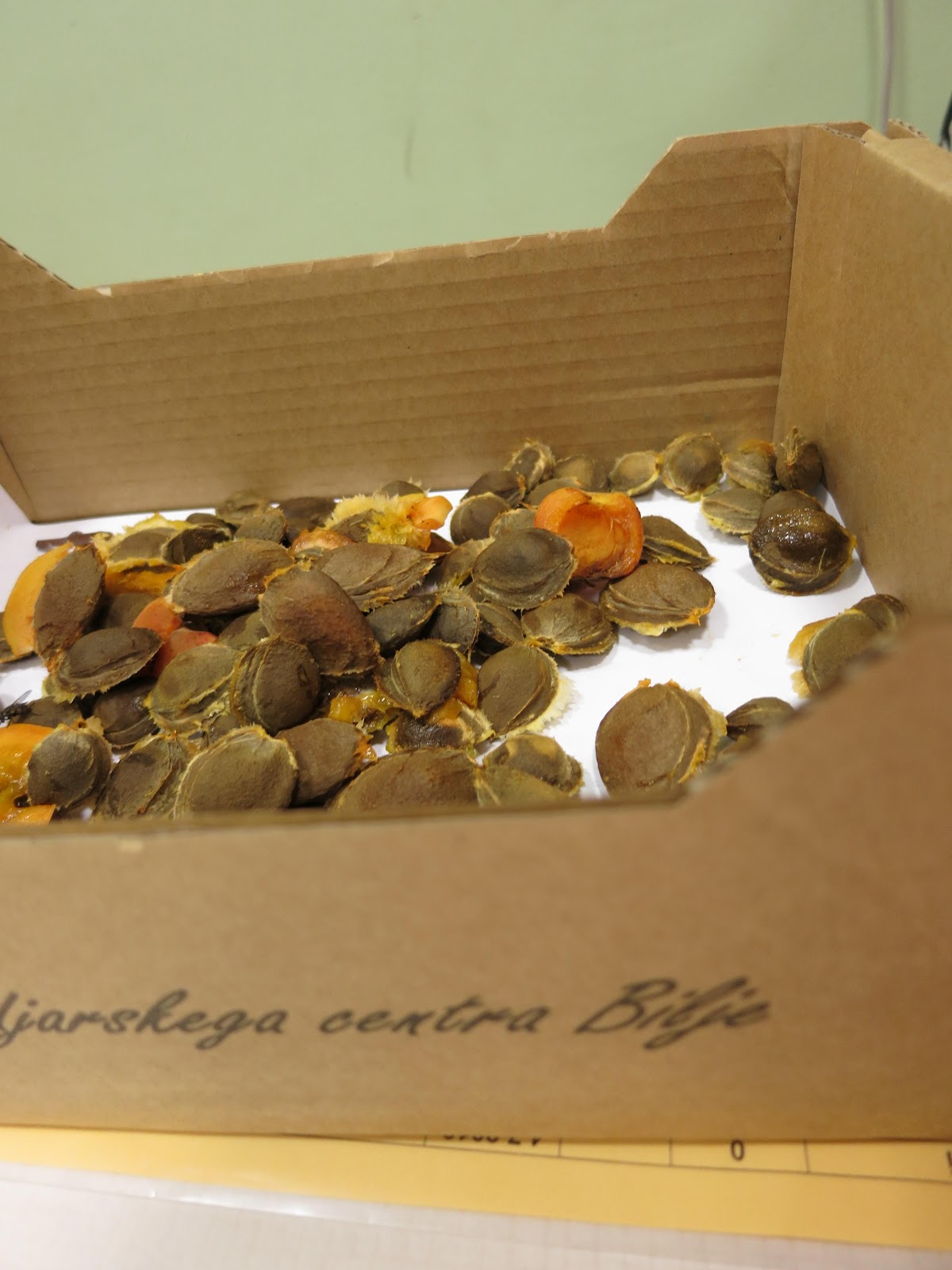
Farming and forestry Institute Nova Gorica, it's branch in Ajdovščina organized a small apricot festival which took place in Planina by Ajdovščina for the first time on this scale. Over 30 apricot varieties grown in Vipava valley and Brda were on display, most of them available to taste. 15 apricot jams from different varieties, made by the same method offered an interesting tasting experience. Amazing what a difference, even greater as tasting apricots raw. Housewife association from Planina prepared a simple menu always using apricots as ingredient. I found tomato-apricot soup with herb croutons superb. Spicy apricot jam was my second favourite.
I hope next year this event will evolve to something even bigger and better promoted. In any case it is worth visiting and tasting. Apricots could give us so much more than just apricot jam or juice.
Apricots did very well this year in Vipava valley and Brda.
Farming and forestry Institute Nova Gorica, it's branch in Ajdovščina organized a small apricot festival which took place in Planina by Ajdovščina for the first time on this scale. Over 30 apricot varieties grown in Vipava valley and Brda were on display, most of them available to taste. 15 apricot jams from different varieties, made by the same method offered an interesting tasting experience. Amazing what a difference, even greater as tasting apricots raw. Housewife association from Planina prepared a simple menu always using apricots as ingredient. I found tomato-apricot soup with herb croutons superb. Spicy apricot jam was my second favourite.
![]() |
| probably not world longest pancake with apricot jam, but it wanished in no time |
![]() |
| Apricot kernels are good source of vitamin B17 |
Tuesday, June 12, 2012
ZELEN
Zelen, Pinela, Klarnica, Vitovska grganja, Rebula are considered indigenous and domesticated to Vipava valley. Zelen is the only indigenous vine of importance (in Vipava valley) as far as I know there are no written records or other sources it was brought from
somewhere else. To determine it's origin and affiliation, genetic analysis has to be done. To my knowledge it hasn't been done yet.
To achieve it's wider recognition first Zelen wine festival was organized in Vipava on Saturday 9th of June. 25 winemakers from Vipava valley offered Zelen samples to taste, from vintage 2011 to 1996. Zelen is a wine considered to be the best consumed about a year old for it's characteristic fragrance which diminishes quite rapidly with age. Tasting available samples surprised me; some wines up to four years old were still not far from what is recognized as typical Zelen. It's aroma is distinctive, complex, unlike any other wine, reminds a bit of fruity-with slight herbal note mix. Apparently the quality of Zelen depends even more than majority other wines from soil and weather conditions. Because of relatively low yield it wasn't popular vine to grow, till recently. In fact in the 80s it was on a brink of extinction with less than 2 hectares planted. In the year 2003 viticulturists who grow Zelen founded co-operative Zelen, which now has 20 members. To design special bottle for Zelen seems to be one of first priorities at that time. Currently there are about 60 hectares vineyards of Zelen in Vipava valley. With tradition and identity gaining importance also Zelen wine is more popular. To produce overall better Zelen wine more field research has to be done along with promotion here and abroad.
| listening to opening speech |
| guided tasting in wine shop Vipava |
| in the year 1969 Mr.Potočnik was issued a reprimand by court for planting Zelen |
Oznake:
indigenous,
Primorska,
Slovenia,
Vipava valley,
Zelen
Friday, May 25, 2012
BORA AND VINE
I doubt strong Bora and vine will ever be very good friends. Bora is one of nature features Vipava valley is known for. During winter on exposed areas it's gusts can reach about 200km/h, causing lots of damage. Unfortunately it can occur also during spring months. As it did at the beginning of May. Strongest Bora battered upper Vipava valley with gusts way over 100km/h, breaking branches and striping leaves from plants. On some exposed areas it looked quite terrifying after Bora ceased to blow. Vine is obviously quite hardy plant. After two weeks the situation in vineyards isn't as bad as it looked before. Fortunately new shoots were not too big, but alrerady strong enough they would suffer complete loss of their crop.
Viticulturists will have more work pruning excess shoots coming out of vine after their tops were broken off.
Saturday, May 19, 2012
CAN YOU SMELL IT? YES WE CAN!
The difference.
Suddenly a black wine glass came on the table. Let's try it, how does an excellent Valter Mlečnik's Sauvignonasse (ex Tokaj, Tocai Friulano) vintage 2007 taste from a black glass? This black glass was standing in a cupboard for a while, so it had to be rinsed first. Accidentally some wine has already been poured into the glass. To check if a spider or some other bug is swimming in it, we re poured it to standard transparent wine glass. Why don't we try to find most appropriate glass for this wine? Soon we had a small collection of five different shaped wine glasses in front of us.
Mlečnik's Sauvignonasse 2007 is a full, complex wine with smell of tropical fruit and a hint of herb mixture, very balanced, smooth in mouth. Must, for those who like natural wine. I'm sure also many of those who aren't into natural wine would like it.
The first glass from left to right was OK, but some aromas didn't come completely developed to expression
The second glass was the best for this wine. Whole range of aromas came to nose, nicely balanced with the taste.
The third glass was also very good, maybe a bit less intensive aromas.
The fourth glass emphasized more high volatile aromas, it seemed to me also more alcohol.
The fifth glass from left to right was at least appropriate, aromas did not develop as in previous glasses.
If you happen to have Mlečnik's Sauvignonasse 2007, for complete satisfaction I recommend to drink it from glass shaped like second or third from left to right.
Na zdravje! (Cheers!)
Saturday, May 5, 2012
PROMOTING INDIGENOUS
Choosing indigenous place to talk about indigenous wine promotion. Erzelj. We were talking about Zelen, Pinela, Rebula and Klarnica, from which truly indigenous wine in Vipava valley is Zelen. Others were brought centuries ago from Greece or Asia Minor and later Italy. Winemakers Andlovic (Avin), Krapež, Mesesnel, Mlečnik, Premrn (Pasji rep), Šušmelj (Miška), Vodopivec (Slavčeva kmetija), Turk (from Erzelj) and biggest wine cellar in the region Agroind Vipava brought their wines to taste. Different stiles of wines ranging from last years to 5 years old, from skin contact of couple of hours to three days and produced naturally or with oenological means. Nice wines.
Miro Kline one of Slovenia's leading experts on branding and consumer behaviour held a lecture which was leading to debate while tasting wine.
![]() |
| For this occasion I prepared green asparagus and cooked beef salad in small flan pastry bowl |
Two of the wines left impression on me:
Zelen, vintage 2011, produced by Trošt Boštjan from Orehovica (who wasn't present) which is supposedly grown from original grapevine clone. The wine was left 3 days on skins, what is not usual for this wine. The wine is very rounded, fine structured, stronger as most of wine this kind, but not heavy.
The second wine was Pinela, vintage 2007, produced by Valter Mlečnik, who is known for his Sauvignonasse, Rebula, Chardonnay and Merlot. Also very different wine from what is considered as typical Pinela. 3-day skin contact, natural viticulture and wine making method makes it quite different from usual. This wine is also full in mouth, complex, but typical acidity for Pinela makes it young and lively. Unfortunately the quantity of this Pinela is so small he didn't even bother to label the bottles, it remains more as an experiment.
![]() |
| Different cork, different wine... |
![]() |
| Wine samples |
Oznake:
Erzelj,
indigenous,
Vipava valley,
wine
Tuesday, April 17, 2012
Wednesday, April 11, 2012
IN THE LAND OF YOUNG AND FRESH
Just recently I visited a small annual wine presentation event in Planina, village on beautiful hills surrounding Vipava valley. Nicely organized and very well visited event. It is dedicated to local grape Pinela, which is in Slovenia cultivated only in Vipava valley. It is hardy plant, whose grape produce enough sugar and nice acidity. Pinela is pleasant and flowery on nose and has fruity flavor. Wine of the future as some like to emphasize.
What was a bit odd to me is that almost every winery present on this event offered only last year's wine. They don't age it. But it is not the case just here, this notion is widespread. It is not because Pinela and other wine wouldn't age well. No doubt, quality vary from year to year and weather conditions, not two vintages are the same. I tried some fantastic Pinela samples, vintage 2008 and 2009. In my opinion ways better, rounder, more balanced as those offered.
Small wineries in Vipava valley started to bottle their wine in the 80's and 90's. Before, they simply sold wine from barrels. The whole wine making process took place in wooden vessels. They tried to sell wine prior to next harvest. Old wisdom says the young wine is ready to drink when grape vines begin to bloom.
Were they wrong?
There is so much talk about identity, terroir, local tradition....
Now most of this "young and fresh" wine is produced in locally made stainless steel tanks, with enzymes and yeasts provided by global corporations.
Local meets global.
Often heard argument is they have to sell fast to get the money needed for everyday living.
Is this the right way? Wouldn't be possible to make more of it by selling higher quality wine? It is not easy to get a piece of overcrowded wine market, but it is sure easier to be spotted if you have something unique than a uniform product.
A few good wineries-winemakers from Vipava valley and surrounding areas prove it.
What was a bit odd to me is that almost every winery present on this event offered only last year's wine. They don't age it. But it is not the case just here, this notion is widespread. It is not because Pinela and other wine wouldn't age well. No doubt, quality vary from year to year and weather conditions, not two vintages are the same. I tried some fantastic Pinela samples, vintage 2008 and 2009. In my opinion ways better, rounder, more balanced as those offered.
Small wineries in Vipava valley started to bottle their wine in the 80's and 90's. Before, they simply sold wine from barrels. The whole wine making process took place in wooden vessels. They tried to sell wine prior to next harvest. Old wisdom says the young wine is ready to drink when grape vines begin to bloom.
Were they wrong?
There is so much talk about identity, terroir, local tradition....
![]() |
| traditional waulted wine cellar with old wooden cascs and new stainless steel tanks |
| vigneron and winemaker in one person also used to make his own cascs |
Local meets global.
Often heard argument is they have to sell fast to get the money needed for everyday living.
Is this the right way? Wouldn't be possible to make more of it by selling higher quality wine? It is not easy to get a piece of overcrowded wine market, but it is sure easier to be spotted if you have something unique than a uniform product.
A few good wineries-winemakers from Vipava valley and surrounding areas prove it.
Oznake:
Slovenia,
Vipava valley,
wine
Saturday, April 7, 2012
SALAMI MAKING CONTEST
![]() |
| 20 salami makers took part at this year's contest hosting at last year's winner home Ambrozic in the village Slap |
![]() |
| hard decision is to be made... |
![]() |
| majority of contestants are from village Slap and neighbouring villages |
![]() |
| most salami were made of non smoked pork, a few had some wild added or even some truffles. Salami were evaluated by it's apperance, smell and taste. |
![]() |
| the winner takes it all...the privilege of preparing next year's contest belong to Andrej Petric from Slap |
Subscribe to:
Posts (Atom)